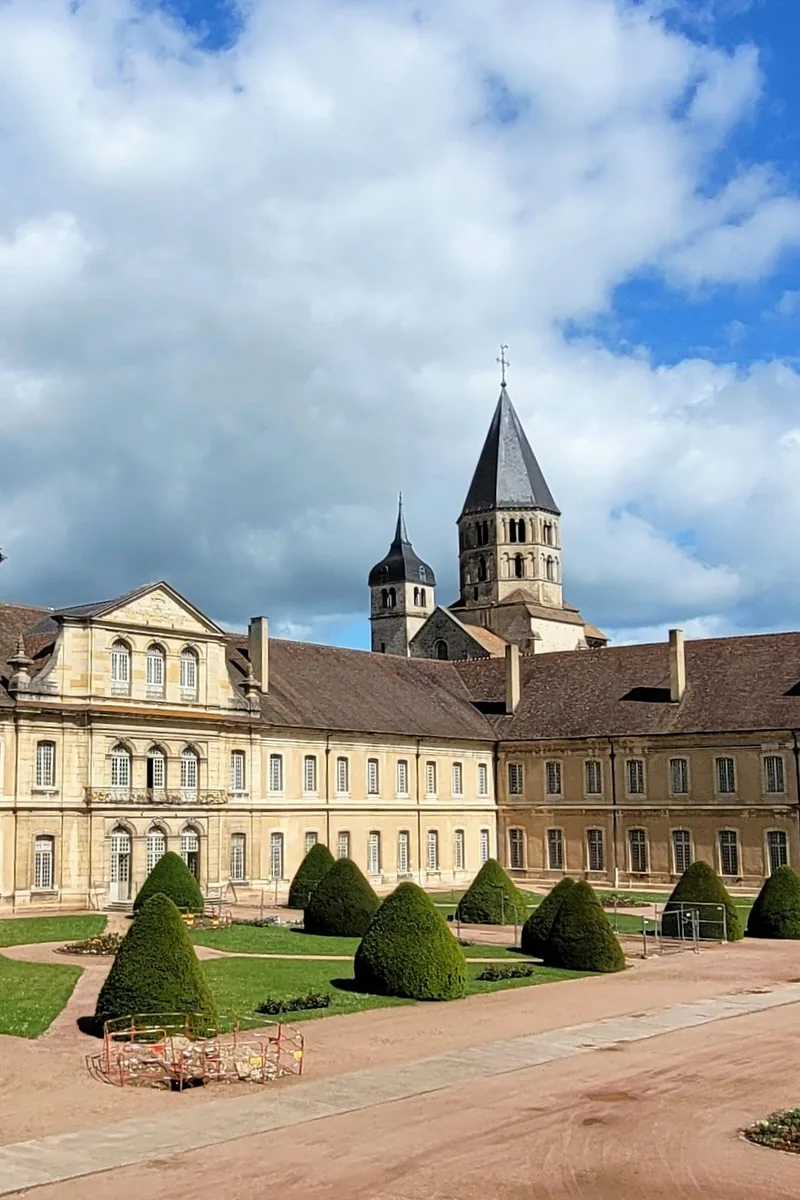
The Abbey of Cluny, in the small town of Cluny in southern Burgundy, was for centuries the most powerful monastery in the medieval West. Founded in 910 by William I, Duke of Aquitaine, and placed under the protection of the Pope alone, it became the head of the Cluniac order — a vast federation that by the 12th century counted hundreds of dependent monasteries across Europe. Its abbots, the first of whom were all later canonised, ranked among the most influential figures of their age, and Cluny stood as the spiritual and artistic heart of Christendom for the better part of two hundred years.
Its ambition reached its height in the third abbey church, Cluny III — the Maior Ecclesia — begun in 1088 under Abbot Hugh. It was the largest church building in Europe, and remained the largest in all Christendom until St Peter's Basilica in Rome was rebuilt in the 16th century. Almost all of it is gone. The monastic buildings and most of the church were demolished after the French Revolution, and the great library and archives burned in 1793; only about a tenth of the vast church survives. What remains is not a whole cathedral but a fragment — and it is all the more moving for it.
Today a single ticket takes you through the surviving south transept, crowned by the octagonal Clocher de l'Eau Bénite, the great bell tower that still rises over the town; the monumental 13th-century Farinier, a vaulted granary that now shelters the carved capitals of the lost choir, among the masterpieces of Romanesque sculpture; the remnants of the abbey precinct with its later cloister and gate; and the Musée d'art et d'archéologie in the Palais Jean de Bourbon. Displays and 3D reconstructions let you picture the immense nave that once stood here, so that you walk not through a museum of what survives but through the ghost of the greatest church in Christendom.